
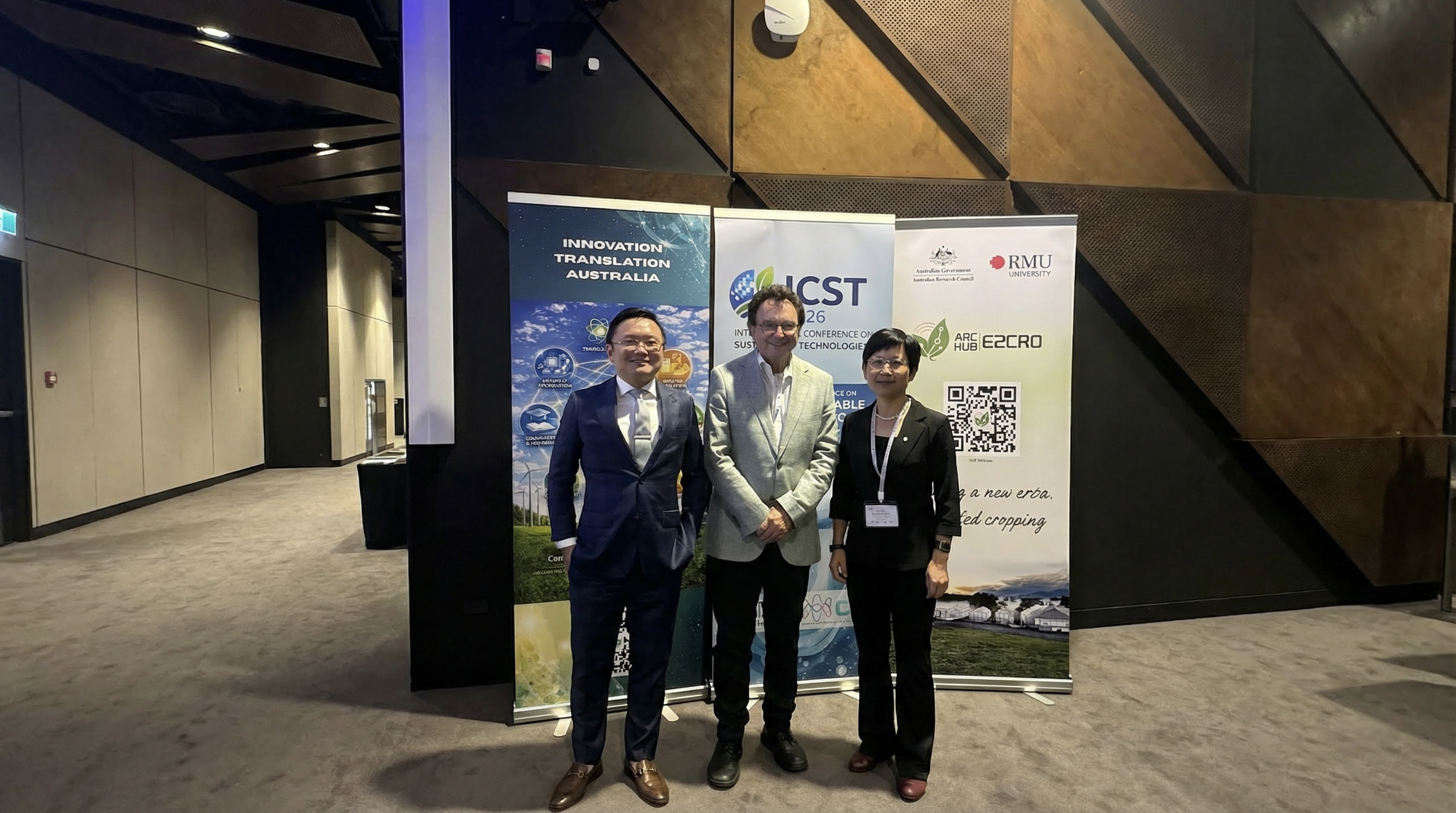
Last week, Alan Cui, Managing Partner at Boson Ventures, had the privilege of speaking at ICST 2026 (International Conference on Sustainable Technologies) — one of Australia's flagship events on research commercialisation. The central question: how do we turn frontier science into products, companies, and real-world impact?
The Innovation Paradox
Australia's research credentials are undeniable — 15 Nobel laureates, WiFi, the cochlear implant. Yet the conversion rate from lab to scalable business remains stubbornly low.
This isn't a capability problem. It's a systems problem. When incentives, capital structures, industry partners, and commercialisation talent aren't aligned, great research struggles to become great companies.
The Five Stages of Commercialisation
- Discovery — A new capability demonstrated in the lab
- Validation — Tested against real market needs
- Productisation — Designed for repeatability, cost, and usability
- Commercialisation — Brought to market with contracts, pricing, and scale
- Institutionalisation — Embedded in industry standards and procurement
Australia's bottleneck sits in the middle: from validation to productisation. The tech works in the lab but struggles to become something deployable, purchasable, and scalable.

Three Predictable Traps
1. Problem-Market Trap
Technology novelty ≠ market demand. Successful commercialisation almost always starts with market pull — real users, real problems, real willingness to pay. Too often, teams validate with academic peers instead of actual buyers and procurement decision-makers.
2. Lab-to-Field Trap
Lab conditions ≠ real-world conditions. Performance degrades. Reliability, maintainability, and manufacturability — afterthoughts in prototyping — become non-negotiable in production. Teams consistently underestimate the resources required to go from prototype to scale.
3. Team & Incentive Trap
Product leaders, regulatory experts, manufacturing engineers, enterprise sales — these commercialisation operators are typically brought in too late. Disciplines work in silos, feedback loops break, and the critical question often goes unasked: who owns the full chain from lab to customer?

Australia's Structural Challenges
Slower feedback loops. A small domestic market means fewer deployment sites and learning opportunities. Distance from major global buyers in North America, Europe, and Asia naturally extends iteration cycles.
Capital gaps at critical stages. Funding gaps persist between grants, seed rounds, Series A, and growth capital — especially in hardware, biotech, and industrial applications. Patient capital remains scarce.
Lower density of commercialisation talent. Product managers, regulatory specialists, manufacturing engineers, and enterprise sales professionals are too thinly spread around research centres.
A Practical Playbook for Acceleration
Start with a "Commercialisation Thesis"
Before investing years of development, clearly answer:
- Who benefits? The end user
- Who pays? The buyer (not always the user)
- Who might object? Procurement, safety, compliance gatekeepers
- What evidence is needed? Technical, operational, and economic proof to convince buyers
Build Binding Industry Partnerships
Select 1–3 industry partners with real deployment authority. Agree upfront on the market need to validate, success metrics, access to real data, decision timelines, and clear next steps post-pilot.
Assemble the Commercialisation Team Early
Bring in a product owner, regulatory lead, commercial lead, and operations or manufacturing lead early — not as advisors, but as accountable owners.
Leverage VC Partners to Accelerate Feedback
Venture partners with deep industry networks can act as a bridge — validating problems, constraints, and willingness to pay. The goal: turn early conversations into an evidence plan and run faster iteration cycles before committing years of resources.

What the Ecosystem Can Improve
Universities and research institutions: Standardise contracts, simplify IP terms, create fast-track pathways. Recognise deployment, standards contributions, and industry impact in promotion criteria — not just publications.
Government and grant systems: Fund validation, not just novelty. Create grant tracks for robustness testing, field trials, and adoption evidence. Stage funding with milestone-based releases tied to external validation.
The Bottom Line
Commercialisation isn't a single grant, a single hire, or a single partnership — it's a system of feedback loops connecting discovery to deployment.
The good news? Most commercialisation failures are predictable — which means they're preventable.
Australia can compete globally by building faster pathways from evidence to adoption. We already have the science. The key is closing the gap between discovery and deployment.
This is exactly the problem Boson Ventures is built to solve. As a deep-tech venture capital firm, Boson Ventures works closely with Australia's leading universities, investing in spin-outs with genuine technical moats and market potential. Boson Ventures doesn't just provide capital — the firm plays an active, hands-on role in the commercialisation journey: helping founding teams close market validation gaps, build industry networks, and accelerate the feedback loop from lab to customer.
Boson Ventures believes Australia's research commercialisation doesn't lack breakthroughs — it lacks systematic support and patient partnership. Boson Ventures aims to be a critical link in that system: connecting scientists with industry, local innovation with global markets, and world-class research with world-class impact.
Join Our Community Today!
Stay updated with our latest insights and news.
Explore Our Latest Insights
Stay updated with our recent articles.
.png)
